Thursday, September 2, 2010

Week 6 last blog for semester 2-Barbara Kruger


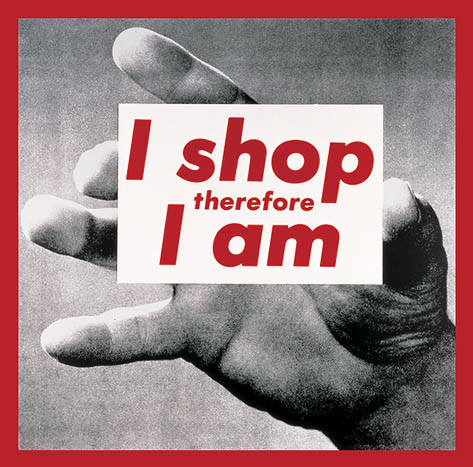
American conceptual/pop artist Barbara Kruger is internationally renowned for her signature black, white and red poster-style works of art that convey in-your-face messages on women's rights and issues of power. Coming out of the magazine publishing industry, Kruger knows precisely how to capture the viewer's attention with her bold and witty photomurals displayed on billboards, bus stops and public transportation as well as in major museums and galleries wordwide. She has edited books on cultural theory, including Remaking History for the Dia Foundation, and has published articles in the New York Times, Artforum, and other periodicals. Monographs on her work include Love for Sale, We Won't Play Nature to Your Culture and others. She is represented in New York by Mary Boone Gallery. A major exhibition of her work will be presented at the Museum of Contemporary Art in Los Angeles in fall 1999, and at the Whitney Museum in New York in 2000.

Research Kruger's work to find an example from the 1970s or 1980s to compare with a more recent work. How has Kruger's work changed with the developments in contemporary visual arts? Describe a recent work that moves away from the 'poster' type work of her early career.
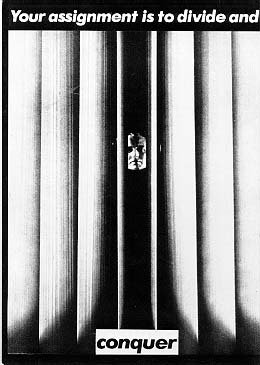

Throughout her career she's used many different mediums varying from beads(simple arts and crafts) to photography. As her career progressed, so did her art. She refined her way of creating art until she found a style that suited her (black and white photo with red. white ban and black/white text). To me Kruger reminds me of Banksy in a way. With both of them having similar meanings in their work, both of the artists are very powerful within their statements. This work kind of reminds me of today’s society, our education system. What makes you think our education system is solid? For we know it could be a sinister plot for world domination for our corrupt leader? < Conspiracy! Lol!
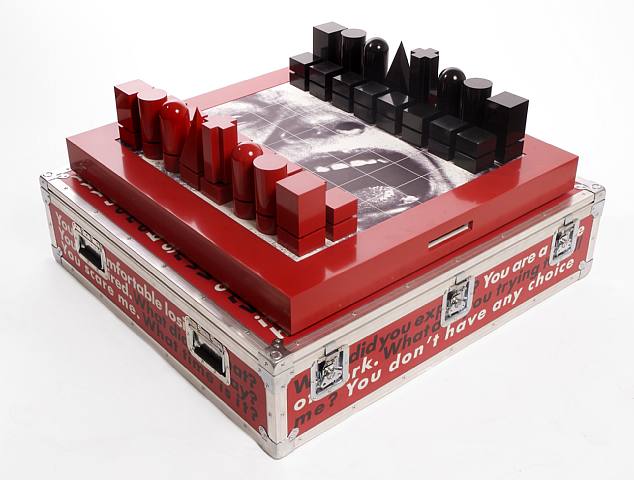


Thought it is a 3d work, you still see the influence of her posters present: the black and white photo and the red back and white coloured texts. The fact that it is a chess set makes this piece interesting. It reminds me of war, struggle against social norms and oppression. The image of the child screaming only assures my opinion even more, with her face being the expression of pain! < Am I even making sense?

Find 2-3 works by Kruger to add to your blog.
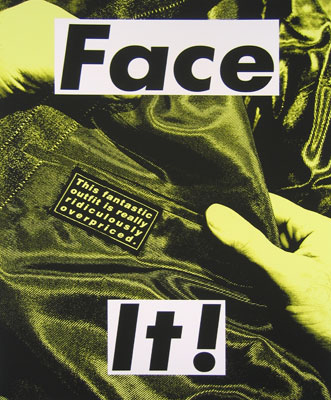


How does the audience experience a more spatial, installation artwork compared with a poster?
For everyone, you get a different answer. For me, the space and the level of interaction with the piece is what separates installation to poster art (which is probably what everyone else experiences> T^T
What elements does Kruger use in her work to create a strong impact?

BIG BOLD LETTERING!
The colours as well complement each other and allow for clear reading. The subjects in her work seem very minimal, so you’re not bombarded with visual information and unusual imagery (e.g. girl screaming, someone pricking their finger, George Bush…etc)

Comment on the development of her work over the last 30 years.

Kruger is very consistent in her approach to art-making. She’s kept true to the monotone colour scheme like style with her posters. Even with her installations and audio works, you cannot escape her unique method. Personally I enjoy Kruger’s work and am thoroughly impressed with her uniformity.

Comment on the examples that you find on other students blogs.

I can relate to Amy’s choice by Kruger of the American flag with text replacing the stars and stripes. It makes me angry, it reminds me of how little I am in society. It’s annoying because it reminds me of what I can’t do and that at the end of the day someone bigger and better than me will/could hold me down because he or she can, is depressing… but that’s just my opinion.

Week 5 - Kehinde Wiley


Last weeks ALVC class focused on the Post Modern them "INTERTEXTUALITY", re-read Extract 1 The death of the author on page 44 of your ALVC books and respond to the oil paintings of Kehinde Wiley. How do we make sense of his Kehinde's work? Identify intertextuality in Kehinde's work?

Wiley's mimetic powers are amazing. He's works consist of traditional and contemporary subjects (e.g. victorian style of prints, the modern african american man). Most of his works are in portrait form, from being just random people on the streets of Harlem to people all over the world. Wiley's paintings are extremely beautiful, usually focusing on one or two subjects present his work. It reminds me of the renaissance types of paintings, maybe he drew some of his inspiration from that and also foregin textiles with a lot of Victorian influences. Also popular culture (e.g. the mary-go-round? > I think that’s what it is…, social groups/signs etc).


Kehinde's work relates to this weeks Post Modern theme "PLURALISM" re-read page 50 and discuss how the work relates to this theme?

Ah yes! Pluralism means the equality of artists regardless of age, race, religion etc. I can see how Wiley's work relates to Pluralism because he’s pieces contain something other than what is ‘expected’ of this type of painting style. This style is a very mimetic form of painting found in the renaissance, and all the paintings produced in that era were of white rich men and their belongings. However in Wiley’s work, his subjects are diverse while still keeping to the traditional painting style. Wiley changes our perception of stereotypes and challenges the viewer to accept the idea of the ‘other’ rather than just accepting what you find in ‘the box’ – so to say.

Monday, August 30, 2010

Week 4- Anish Kapoor

Celebrated for his gigantic, stainless steel 'Cloud Gate' sculpture in Chicago’s Millennium Park, Anish Kapoor is changing the cultural environment with his public works.

1.Research Kapoor's work in order to discuss the ideas behind 3 quite different works from countries outside New Zealand.
It was really hard to find information on Kapoor's work, but here goes nothing!

Descent Into Lim Kassel, 1992
I'm not too sure what this working is trying to say, but just by looking at it, it reminds me of modern architecture with its square faces and the attitude of 'what you see is what you get'.

The Earth London, 1991
I love the empty space in this installation. It reminds me of the birth of something. I love how the windows allow the light to flow through into the space and reflect off the white walls... just beautiful.

Non Object (Door), Non Object (Pole), Non Object (Vertigo), 2008
This work makes me curious. I feel like wanting to explore the different ways of looking at something through the model. I like the almost hour glass like mirror the most, because of its ability to reflect both the floor and ceiling (< it sounds like it doesn't take much to impress me. lol. T^T)


2.Discuss the large scale site specific work that has been installed on a private site in New Zealand.
Made from steel and fabric, Kapoor's The Farm is a massive outdoor installation. This sculpture is said to be strong enough endure bad weather, but the fanscinating about this piece is that if you looked through one end of each side of the sculpture you would see: Vertical side = the habour, Horizontal side: the vally.

3. Where is the Kapoor's work in New Zealand? What are its form and materials? What are the ideas behind the work?

Kapoor installation is located on a private farm in Kaipara Bay. it kind of looks like a Thankgiving horn , or maybe that's just me. It's made from ellipse shaped steel rings and fabric is PVC Polyester fabric. This massive installation weights a wooping 50,000kgs! Ideas behind the work? Well... yea, about that. I couldn't find thing on themes, but.
Err... To provoke a reaction? It reminded me, about

4. Comment on which work by Kapoor is your favourite, and why.

Sea Mirror

I just thought it was gorgeous! :D I loved everything about it! It's probably because I have quite a lot of great memories of being at the beach as I child, that I have a strong interest to this piece. I love the colours of the beach, green, yellow, blue, whites and having this HUGE MIRROR reflecting all that... I dunno, it just makes me happy.

Monday, August 16, 2010

Week 3 - The Walters Prize 2010

Week 3 - The Walters Prize 2010

1. What is the background to the Walters Prize?
Founded and named by a NZ artist called Gordon Walters. It’s one of the more recognized contemporary art awards where the winner of the prize receives $50, 000 and a trip to the exhibition at the Saatch and Saatch Gallery in New York.

2. List the 4 selected artists for 2010 and briefly describe their work.

It wasn’t to my liking. It was all weird and I kinda felt that I wasn’t really grasping the message.

Dan Arps: Explaining Things
- Mixed media… a.k.a a bunch of CRAP!

Fiona Connor: Something Transparent
- Plastic, Acrylic, wood.

Saskia Leek: Yellow is the Putty of the World
- Oil on board.

Alex Monteith: Passing Manoeuvre with Two Motorcycles and 584 Vehicles
- Two-Channel Video. Shown on Large display screens.

3. Who are the jury members for 2010?
The Jury Members for 2010 are:
Jon Bywater - Programme Leader, Critical Studies at Elam School of Fine Art, The University of Auckland.
Rhana Devenport - Director, Govett-Brewster Art Gallery, New Plymouth
Leonhard Emmerling - Visual Arts Adviser, Goethe Institute, Munich, Germany, former Director, ST PAUL St, AUT University
Kate Montgomery - Director, Physics Room, Christchurch

4. Who is the judge for 2010 and what is his position in the art world?
The Judge this year is Vicente Todoli, who once was the director of London's Tate Modern (a well recognized museum for modern art). Vicente Todoli has also directed many exhibitions for many modern artists in the past, making him an idea choice for judge.

5. Who would you nominate for this years Walter's Prize, and why?

Substantiate you answer by outlining the strengths of the artists work. How does this relate to your interests in art? What aspect of their work is successful in your opinion, in terms of ideas, materials and/or installation of the work?

I would choose Saskia Leeks work. It felt quite naïve, but the main reason why I like it was because it reminded me of an old beach house with faded flaking cream walls and the clichéd blue white strip cushions. I doesn’t relate to any of my interests in art, but it reminds me of good memories. I guess the use of soft colours, the yellows, blues purples and whites were quite successful, I think it turned out really well.

Monday, August 9, 2010

Week 2 - Hussein Chalayan

Week 2 - Hussein Chalayan

Hussein Chalayan is an artist and designer, working in film, dress and installation art. Research Chalayan’s work, and then consider these questions in some thoughtful reflective writing.

1. Chalayan’s works in clothing, like Afterwords (2000) and Burka (1996) , are often challenging to both the viewer and the wearer. What are your personal responses to these works? Are Afterwords and Burka fashion, or are they art? What is the difference?
I thought it was a bit awkward when I first saw it, for obvious reasons. It made me feel quite uncomfortable and looked degrading. To be honest I’m not quite sure what separates art and fashion, but they both hold a strong significance, which is expected from genres. One the other hand I would say art, because there is no way women would wear a table/skirt out (ANYWHERE) because of its non-practicality.

Not all clothing is fashion, so what makes fashion fashion?
I don’t know what makes fashion fashion, but I’m thinking something that has a strongly influence on others. If it’s worn by a celebrity or created by a highly recognised designer… it probably would be considered fashion – though sometimes you get ones that look completely outrageous. >.<


Hussein Chalayan, Burka, 1996


Hussein Chalayan, Afterwords, 2000

2. Chalayan has strong links to industry. Pieces like The Level Tunnel (2006) and Repose (2006) are made in collaboration with, and paid for by, commercial business; in these cases, a vodka company and a crystal manufacturer. How does this impact on the nature of Chalayan’s work? Does the meaning of art change when it is used to sell products? Is it still art?
I don’t think it really changes anything. It is still Chalayan’s work. It is still art. Just because a commercial company funded the piece doesn’t make it less of an art piece. And no, I personal don’t think art changes when selling products. Isn’t it all about art/design to help promote the product (regardless if it’s a high or low form of art)?

3. Chalayan’s film Absent Presence screened at the 2005 Venice Biennale. It features the process of caring for worn clothes, and retrieving and analysing the traces of the wearer, in the form of DNA. This work has been influenced by many different art movements; can you think of some, and in what ways they might have inspired Chalayan’s approach?
To be completely honest. I not really sure.
Hussein Chalayan, still from Absent Presence, 2005 (motion picture)
4. Many of Chalayan’s pieces are physically designed and constructed by someone else; for example, sculptor Lone Sigurdsson made some works from Chalayan’s Echoform (1999) and Before Minus Now (2000) fashion ranges. In fashion design this is standard practice, but in art it remains unexpected. Work by artists such as Jackson Pollock hold their value in the fact that he personally made the painting. Contrastingly, Andy Warhol’s pop art was largely produced in a New York collective called The Factory, and many of his silk-screened works were produced by assistants. Contemporarily, Damien Hirst doesn’t personally build his vitrines or preserve the sharks himself. So when and why is it important that the artist personally made the piece?
There are no limits to creativity, however sometimes some ideas; for it to be executed correctly may need the assistance from others. And example of an artist who uses a lot of assistance for his large-scale sculptures would be Richard Serra. However I do think there should be a balance in the artist’s environment which would help contrast his work.

Monday, July 26, 2010

Semester 2- Week One

Semester 2- Week One
Nathalie Djurberg's 'Claymations'.


Swedish artist Nathalie Djurberg's intricately constructed claymation films are both terrifyingly disturbing and artlessly sweet.


The new works created for the Venice Biennale explore a surrealistic Garden of Eden in which all that is natural goes awry.


She exposes the innate fear of what is not understood and confronts viewers with the complexity of emotions.

Nathalie Djurberg was awarded the silver lion for a promising young artist at the Venice Art Biennale 09.
(http://www.designboom.com/weblog/cat/10/view/6886/nathalie-djurberg)


1. What do you understand by the word 'claymation'?

Claymation is a form of animation. ‘A form of stop animation using clay’ (Para 1). Claymation was a term devised by Will Vinton who worked with artist in his studio to create these types of animations.
‘Claymation involves using objects or characters sculpted from clay or other moldable material, and then taking a series of still pictures that are replayed in rapid succession to create the illusion of movement.’ (Para 1).

(http://www.wisegeek.com/what-is-claymation.htm)

2. What is meant by the term 'surrealistic Garden of Eden'? and 'all that is natural goes awry'?

I’ve come to the conclusion that it’s her interpretation of the opposite version of the Garden of Eden. Compared to the original stories of its beauty, she’s definitely made the paradise grotesquely awkward, which make it interesting as a art piece.

3. What are the 'complexity of emotions' that Djurberg confronts us with?

Djurberg confronts us with a lot of information. The emotions can vary from anger to confusion to fear and even masochism. She portrays this very will with the use of her disturbing characters and the scenarios she has them in.

4. How does Djurberg play with the ideas of children's stories, and innocence in some of her work?

One of the many ways Djurberg creates such complex emotions is using the naïve figures of children stories. She plays on the idea of the innocent being not so innocent, which becomes relatable on our level.

5. There is a current fascination by some designers with turning the innocent and sweet into something disturbing. Why do you think this has come about?

Turning something innocent to something corrupt is kind of what our world has turned into. We’re bombarded with so much information that our generation tends to gain prejudices and other filthy habitats at a younger age. It fits perfectly in our society. It also can be said that innocence is over rated (http://articles.sfgate.com/2007-03-07/bay-area/17233740_1_sexual-encounter-innocence-nicely) and that the more grotesque outlook on things make for a more interesting design or work.

6. In your opinion, why do you think Djurberg's work is so interesting that it was chosen for the Venice Biennale?

The tremendous amount of time and effort that had been out into making such a complex film is amazing. The craftsmanship is very impressive and it not only looks good, but to have meshed to totally different ideas together and made it work, is just AWESOME! This definitely deserves to be the in Biennial.

7. Add some of your own personal comments on her work.
Just brilliant. I’ve never seen anyone do something quite like what Djurberg’s work. It’s a refreshing look on art. :D

Tuesday, May 25, 2010

Last blog question for semester one- Banksy's work

How can we categorize Banksy's work -graffiti or murals?

Research Banksy's work to attempt to answer this question.
What are some of the differing opinions about Banksy's work?
How does his work sit in relation to consumerism? Can his work be sold?
What are some of his attitudes to the sale of Art?
Who is Banksy? Do we know his true identity?
Upload 2-3 images of Banksy's work that you find interesting, and comment
on the ideas behind the work.


Personally, Banksy is one of my most beloved artists. His work is truly AMAZING!

Baknsy’s work is very politically interwoven. He provides a humorous insight to today’s society with thought provoking images, for example: kids pledging their allegiance to a ‘Tesco’ (Tesco is a British international grocery and general merchandising retail chain) plastic bag; a little man looking down at the price tag under the frame he’s in saying: “You have got to be kidding me..”; and policemen on motorbikes protecting a donut van to name only a few. Because Banksy’s work is mainly graffiti orientated, it’s appealing to the younger generation. Graffiti isn’t considered art, but a destructive way of ruining property. It’s also illegal. However Banksy’s work for some is considered as a mural yet for others it’s just graffiti.

In relation to consumerism, Banksy’s work isn’t for sale. However people do profit from his work by selling his work on different media e.g. t-shirts and canvases.

‘Products not actually included, serving suggestion only. All images are made
available to download for personal
amusement only, thanks.
Banksy does not endorse or profit from
the sale of greeting cards, mugs, tshirts,
photo canvases etc. Banksy is not on Facebook, Myspace, Twitter or Gaydar.
Banksy is not represented by any form
of commercial art gallery.’
(http://www.banksy.co.uk/shop/index.html)

Despite much speculation, no one truly knows the identity of Banksy. I think by his lack of retial he is able to seclude his identity. In a statement taken from his website:

“I am unable to comment on who may or may not be Banksy, but anyone described as being 'good at drawing' doesn't sound like Banksy to me.”
(http://en.wikipedia.org/wiki/Banksy)

3 pictures:


As soon as I saw this piece it reminded me of the war in Iraq. It made me laugh because I thought the statement was about right.


This work reminds me of Jun’s work. It also made me think of child labour and exploitation of children and how it’s mainly adults who enforce children to do their dirty work.


Because Policemen have been stereotyped to eating donuts, when I saw this piece I couldn’t stop laughing. To see them protect something they love, it’s hilarious!


http://en.wikipedia.org/wiki/Tesco
http://www.artofthestate.co.uk/banksy/banksy_tesco_pledge_your_allegiance.htm
http://www.banksy.co.uk/indoors/kiddingme.html
http://www.halifax.ca/corporate/graffiti/whatisgraffiti.html